Showing posts with label rowan willow. Show all posts

November 28, 2018

Maintaining One’s Own Heavenly Form in Contrast with the Undefinable Beauty of Landscape and the Harsh Conditions of Nature

Maintaining One’s Own Heavenly Form in Contrast with the Undefinable Beauty of Landscape and the Harsh Conditions of Nature
By Rowan Willow
White Sands
November 13, 2018


It’s shocking that if you take one little nap on a big ol’ sand dune you get so much hotter than all of the sand in the whole damn dune field. Please, God, reconstruct me so I am made of gypsum and I no longer have this lousy sandal tan.

November 25, 2018

Disturbance Vs. Destruction

Disturbance Vs. Destruction
By Rowan Willow
Gila
November 13, 2018
Holy heck! There are so many mushrooms in the Gila. Patches of massive and delicate silver mushrooms the size of your head erupt from the base of trees. Entire fallen trees are lined with perfect rows of velvety turkey tails. Deep reddish brown mushrooms that feel almost like Styrofoam are nestled in the brush on an old stump. During my first mushroom haul, I showed Erin a handful of some of the silver ones by my campsite and she exclaimed “THERE'S SO MUCH ABUNDANCE HERE, IT ISN’T REAL.”


All those mushrooms are the final stage in the life cycle of complex mycelial networks that exist in a clandestine subterranean landscape just under our feet. These exist to the fungi to solely spread spores, although in that process they become food for many species and a source of wonderment for me, specifically. Disturbing and picking mushrooms can be good for the wellbeing of the mycelial population, because it can help spread spores faster and over larger areas. Still, the relationship between me and the mushrooms was important, so I asked each one if I could pick it. That brings up a lot of questions about human relationships to plants. We all know overharvesting can lead to decline of a population, which can lead to larger ecological consequences, but we also can’t separate our lives from the lives of plants. They feed us and inspire us and build our homes, and we can’t just export the task of removing them from the ground as an attempt relieve our own guilt. Sometimes, beauty can be disturbed in order to make other beautiful things, and if we don’t remove ourselves from the “natural world,” we can take part in that full practice and focus on healthy methods of harvesting and honoring the plant that gave its life for us. We have separated ourselves so much from spaces of abundance like the Gila that our own presence in them makes us uncomfortable, partially because we know we are a force of destruction. But we don’t have to be. We can work with nature instead of in opposition to it.


November 18, 2018

Design in Oppression

Design in Oppression
By Rowan Willow
Nogales
November 13, 2018 


Visiting the border fence in Nogales, Arizona brought up a lot of troubling and conflicted feelings for most of us. Even though the fence is a consistent political issue in contemporary American life, one that is constantly being discussed on the news, social media, and in our everyday lives, many of us had never seen it. While we can have a theoretical view of deeply complex political issues based on how much we know, and how we process these layers of information, I doubt many political issues have such a concrete physical manifestation as this fence and the other historical walls built to keep people out. One immediate impression of the fence is that it is aesthetically pleasing. The way it dissects the clear blue sky, the linear shadows settling themselves across the topography of the environment, and the snakelike creeping of it along the dramatic hills of Nogales as far as you can see in both directions marked it some sort of twisted beautiful object. If the term “power” can be used from a purely visual standpoint that does not call upon oppressive political structures or a bloody history, then the power of the fence was magnificent. But, because it cannot be disambiguated from those aspects, it was horrifying and macabre.


Life continued on both sides of the fence. The day was beautiful, gourds grew plentifully, and music and laughter came from the southern side. The northern side was much quieter- we seemed much more afraid of it. Cats and birds took no mind to it and crossed it as they pleased. The fence is an obstacle for some, and an easily avoided structure for others. Water doesn’t resist it, nor do root structures, nor plants that rise through cracks in its concrete base. No matter what injustices are imposed upon people, life must continue. That’s another thing that is both terrifying and beautiful.


October 19, 2018

Trying to Stay Dry in a Desert

Trying To Stay Dry in a Desert

By Rowan Willow

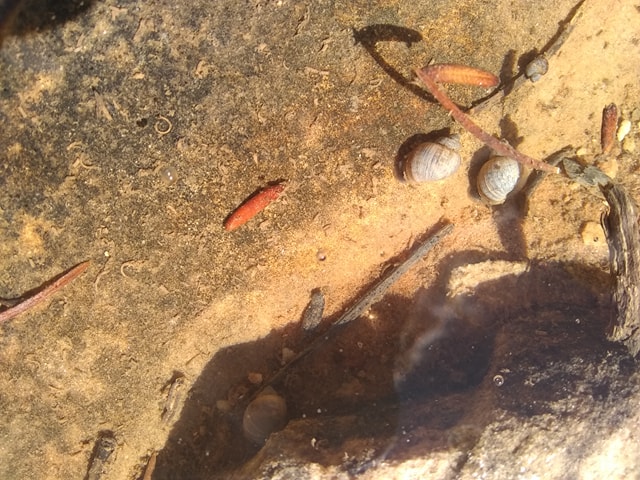
Where do tiny lil bb underwater creatures come from in the desert, and how do u learn from them?

Part of being caught in a thunderstorm in Muley Point was making sure my tent stayed dry and making sure I could create an oasis to come home to every night after a day of working in the rain. When I would come home to my tent at night (and mind you, in the fog and the endless similarities of the landscape, it wasn’t easy) I would consistently squirm with delight when I would come back to my dry ecosystem- as if I were subverting the current harshness of my environment. As someone raised in the desert, the thunderstorm was hard, but it was also a rare luxury that I often did not get to experience. This moment was shared with me by all of the tinaja creatures. Finally, after an especially long and dry summer, the bowls held within the rocks filled up, and their ecosystems were resurrected. My daily oasis of a dry tent was parallel to their wet oasis within the rocks that happens, well, as often as it rains in the desert (variable).

The first morning the thunderstorm got particularly scary, I asked Jenn about the lil bb’s, and her advice was to go and learn from them. I did go and hang out with them, but I don’t know what I learned. I feel like lessons like that do not become apparent to you until much later.
Were both bb’s tryna live in environments that do not nourish us with the regularity that we’d perhaps like.

But we’re strong,

And it’s going to be okay (MAYBE).

We need to take the nourishment that is provided to us, and we must create our own ecosystem.

I don’t know where either of us come from, but I know where we are. I know more lessons will come. It’s funny how significant a passing experience will be when it’s no longer there.


October 16, 2018

The Tower (Fracking at Greater Chaco)

The Tower (Fracking at Greater Chaco)
By Rowan Willow

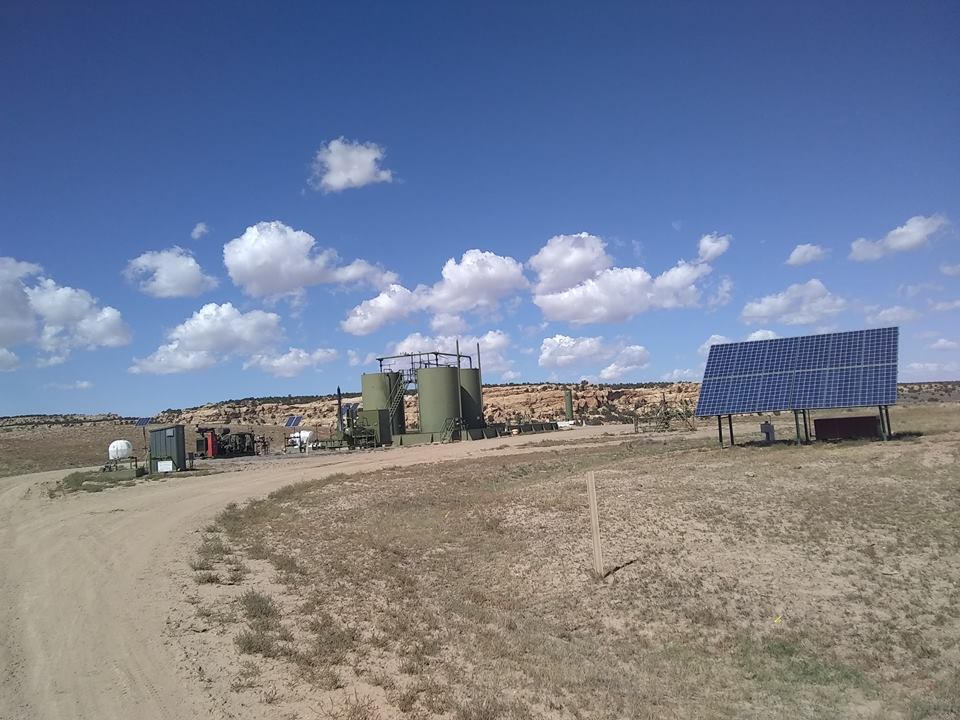
few of the fracking wells at Greater Chaco are visible from highway 550. Some of the storage facilities and refineries look menacing, but the wells themselves don’t look imposing at all. If you were to drive by without the knowledge of the current struggle of the area with Big Oil, you might not notice anything out of the ordinary. Such large, oblong, sleekly painted shapes are a staple of highway life in the country, probably other countries as well. Chaco is a monument, ruins that can never be touched. Everything else is just business as usual.

These wells are fracturing communities. They affect the mental and physical health of the indigenous communities whose ancestors grew this land and worked with the magic of this place.

When I think of the fracking in the greater Chaco region, I think of the Tarot Card The Tower. The card is unanimously agreed to be a reference to the Tower of Babel, a tower where we tried to reach God through the heavens, and God- knowing we could not reach Him, made language divide so we could no longer communicate. The story does not communicate a disaster, instead it provides hope. The doorway on the card signifies that people were not forced to leave, they left out of their own volition, because the way to communicate with God is not through unattainable ideals, but through connection and cultivation of the earth.
Maybe our world is set up to make money off its exploitation, and maybe that exploitation will be realized until there is nothing left. But no matter how much we try to build our tower to utopia through oil, we will end up with the realization that we will only attain this utopia through working and understanding the earth and its wisdom.


October 3, 2018

Feel Free to Play!

Feel Free to Play!
By Rowan Willow
Wild Rivers
September 18, 2018
All work and no play makes the earth very, very sad. You need to play with the earth with your hands and you need to play with concepts with your mind. Play doesn’t mean you have to understand. You don’t have to understand why that branch is broken in the way it is, or why it curves like that or even which organism it comes from. You don’t have to understand how or why or if divination works to toy around with the idea.
For the tenth annual NeoRio festival in Wild Rivers, I created a toy like those doctor’s office toys kids play with where they bat around blocks with shapes and numbers attached to some sort of metal rod which allows for limited movement of the object. I lovingly (and very incorrectly) referred to it as my metaphysical abacus. I gathered objects from the environment (mostly sticks and pinecones, with a few logs and a single feather), drilled holes through them, and strung them up between two trees. There were seven levels, going from the ground to above your head. On the bottom I painted concrete concepts, like shapes and letters, and gradually as you went up the levels the concepts I painted on the objects got more complex. It went through insects to animals, to ideas attached to the earth, to very human ideas, to heavenly ones. The idea was there were concepts appropriate for all age ranges, so everyone could play!
I wanted to get people back to their roots of childhood wonder, but I also wanted a multigenerational family friendly environment. During the festival, I was very happy to see every age range play with it, both very young and very old.