Showing posts with label Patagonia. Show all posts

November 24, 2018

no.5

no.5

By Sarah Canelas

Patagonia, AZ


October 19, 2018


November 20, 2018

dogs bark, crickets chirp, agaves grow

dogs bark, crickets chirp, agaves grow
in and around Patagonia, Arizona
Jess Zeglin


A dog stands barking at the intersection of the Calle Internacional and a street I can’t see the name of through the fence. She is casually informing me not to infringe on her territory. I wanted to make friends with this dog, but in order to do so I would have to climb up and over the massive barrier or find my way to one of only a few border crossing and the many bureaucracies, fears, and threats awaiting there. Instead, the dog and I just stare at each other while I wave hello and she continues to bark at the strange human across the street. For several minutes this interaction occurs, me waving and saying hi, her barking to determine if I really am a threat. Am I? Physically, no - I would never make it on the climb up the three story monument to nationalism sitting between us. Politically, socially, maybe I am. Eventually the pup decides I’m not worth the trouble. She slumps down into a good-natured pile of fur to nap in the sun. I walk away from her, footsteps crunching on the gravel of the border patrol road, back to the American side of a landscape that has no interest in being divided.


Standing in a field of tall grasses at dusk, recording a constellation of cricket sounds while feeling the oceans of grass rustle around me. I’m standing as still as possible to get decent audio, attempting to ignore the hungry, itchy mosquitos that have discovered my foolishly unmoving self and are taking advantage of the available meal. Realizing that this eternal-feeling hillside is actually part of a luxury home development property and will likely be transformed to faux-adobe buildings with nice pools before the next time I can come back and visit.


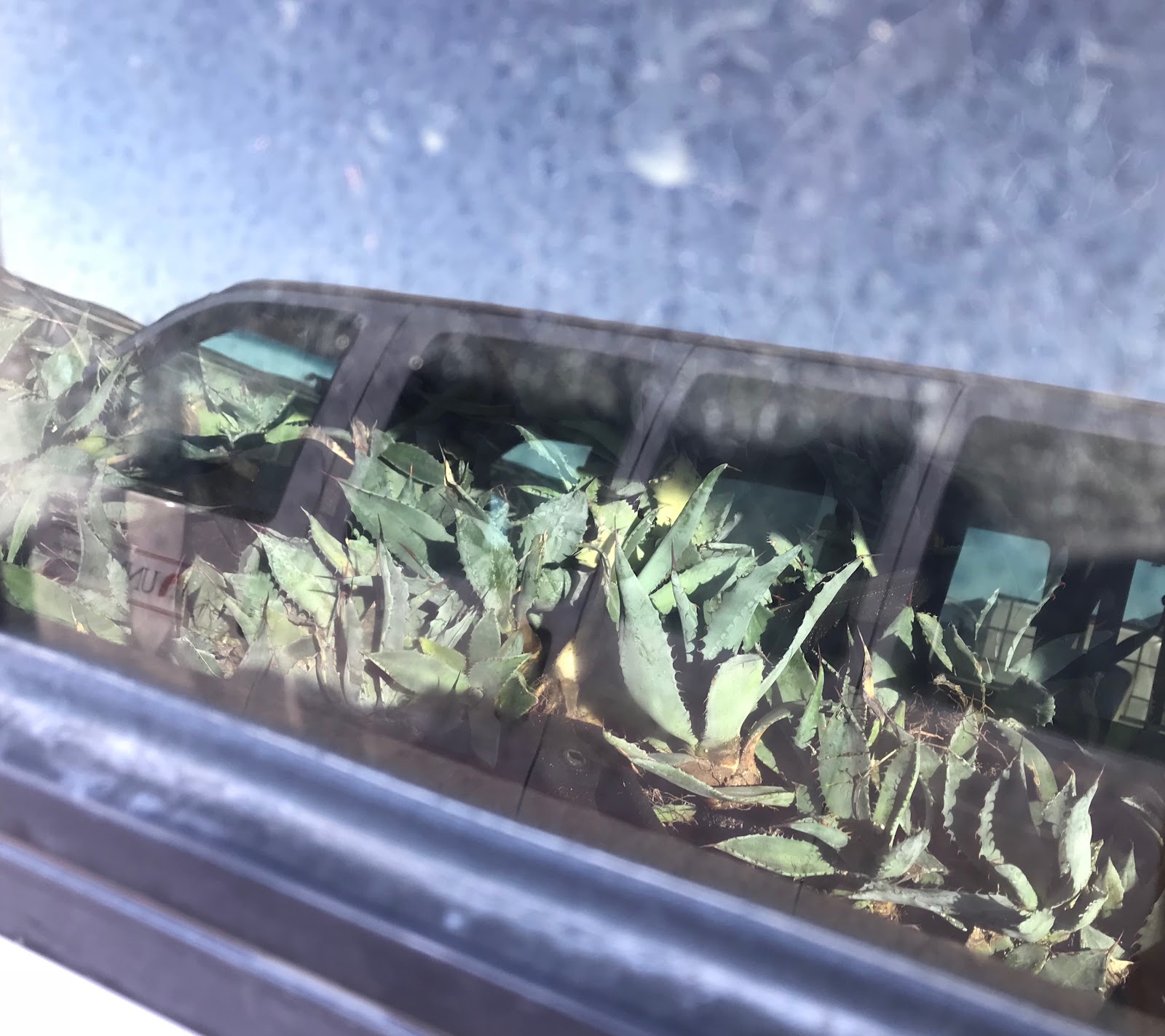
Meeting baby agaves for the first time, learning about how they are suffering population losses due to climate change, use in tequila and bacanora industries, and general disregard. Visiting a clonal agave patch that has grown in the same place for centuries and was likely established and cultivated by ancestral indigenous people to whom this land was a corridor of life. Planting baby agaves in what we hope will be a brand new patch, a small but deeply moving gesture of hope and solidarity with generations before and after us.

November 18, 2018

Design in Oppression

Design in Oppression
By Rowan Willow
Nogales
November 13, 2018 


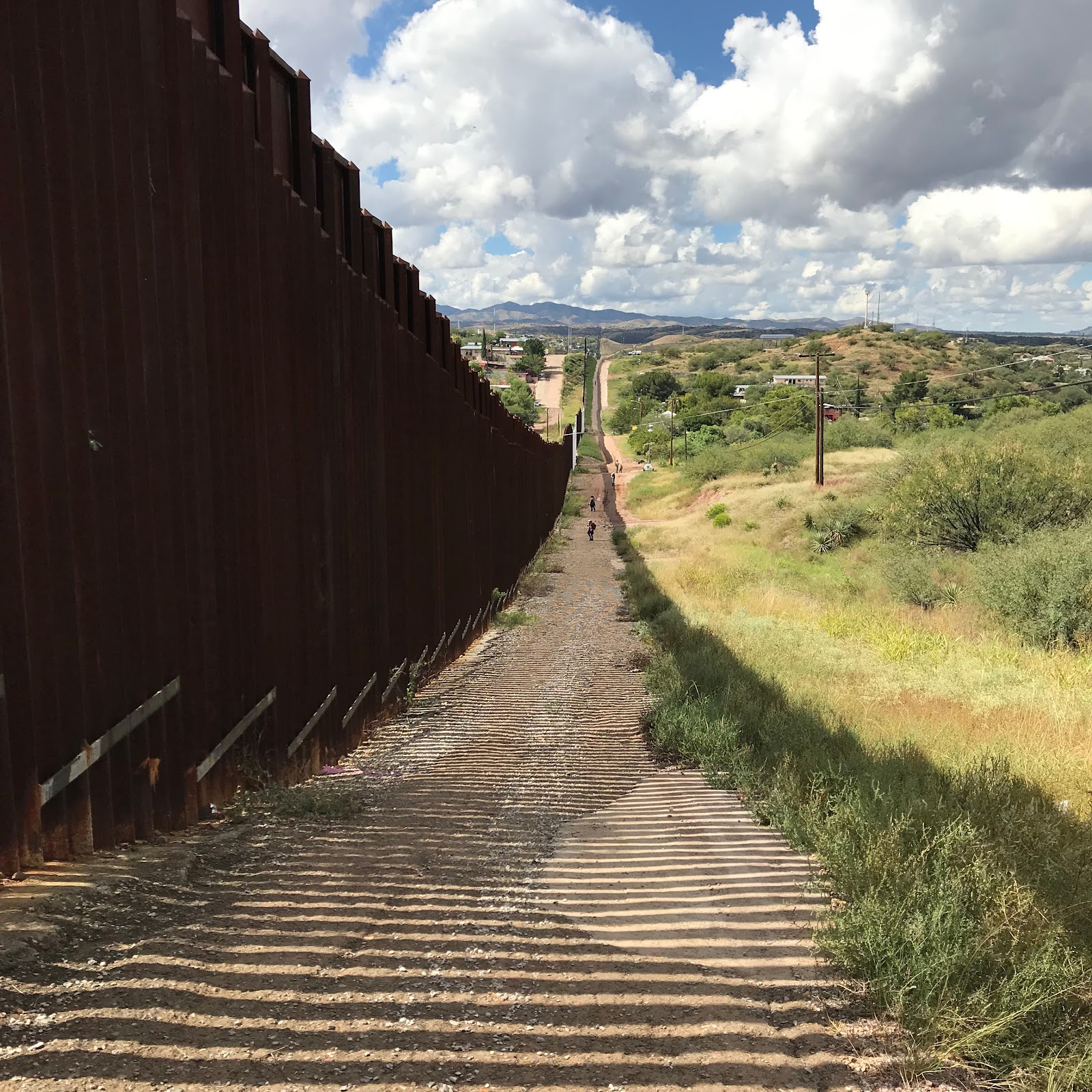
Visiting the border fence in Nogales, Arizona brought up a lot of troubling and conflicted feelings for most of us. Even though the fence is a consistent political issue in contemporary American life, one that is constantly being discussed on the news, social media, and in our everyday lives, many of us had never seen it. While we can have a theoretical view of deeply complex political issues based on how much we know, and how we process these layers of information, I doubt many political issues have such a concrete physical manifestation as this fence and the other historical walls built to keep people out. One immediate impression of the fence is that it is aesthetically pleasing. The way it dissects the clear blue sky, the linear shadows settling themselves across the topography of the environment, and the snakelike creeping of it along the dramatic hills of Nogales as far as you can see in both directions marked it some sort of twisted beautiful object. If the term “power” can be used from a purely visual standpoint that does not call upon oppressive political structures or a bloody history, then the power of the fence was magnificent. But, because it cannot be disambiguated from those aspects, it was horrifying and macabre.


Life continued on both sides of the fence. The day was beautiful, gourds grew plentifully, and music and laughter came from the southern side. The northern side was much quieter- we seemed much more afraid of it. Cats and birds took no mind to it and crossed it as they pleased. The fence is an obstacle for some, and an easily avoided structure for others. Water doesn’t resist it, nor do root structures, nor plants that rise through cracks in its concrete base. No matter what injustices are imposed upon people, life must continue. That’s another thing that is both terrifying and beautiful.


November 17, 2018

f--- that fence

Erin Gould
Nogales, AZ
October 16, 2018


Though I have been living in New Mexico, a border state, since 2013, it was my first time seeing a border fence, a physical, metal, regular, orderly, imposing manifestation of our made up line between "us" and "them". It was oddly normal. 

The normalcy is oppressive.

I should have hated this object, this symbol, but I kind of liked it. 

I was also highly aware of my body in that space, one protected by white privilege, and the feeling of state surveillance on my skin. That strip of cleared land felt dangerous.

I don't know if I have ever consciously felt that level of cognitive dissonance.

Paco asked us to take in this place in silence, an instruction for which I was grateful. Otherwise, we may have just been chatting.

I found myself drawn to the plants that were reaching through those even, bright, framing negative spaces in the fence. Do you think those mesquite know how transgressive their branches are?


I'm probably not supposed to swear here but fuck that fence.


I was listening to NPR yesterday morning and heard this story:

   "Newly elected Democratic mayor Arturo Garino was busy with Election Day when the Army arrived in Nogales and started erecting coils of glistening razor wire along the tops of the border wall that separates his small U.S. town from its sister in Mexico.

    "Razor wire, concertina wire is not what you want to see on a fence with two countries that have been friends and traded forever," he said.

     President Donald Trump announced a little more than a week ago that he was sending troops to the border to support U.S. Customs and Border Protection.

     "And now here we have a wire, you know, downtown, el puro downtown," Garino said."

What does the fence look like how? How much different would I feel in that space? How much different is the experience of the people who see and interact with that fence everyday? What does it feel like to have razor wire bisecting your town? 

Fuck that razor wire.


(ALSO--- check out Borderlands Restoration Network and all of the amazing work that they are doing to combat the ecological and community harm wrought by the physical and conceptual border at:
http://www.borderlandsrestoration.org/ )

(ALSO--- thank you to everyone at BRN that met with us, Perin in particular for her late night map workings, and Francisco CantĂș and Karima Walker. It was so lovely working with you all.)

November 16, 2018

A Place to Pray/ Bats Without Borders: Agavaganza

A Place to Pray

Brionna Garcia

Nogales Border

November 11, 2018


The border which divides Mexico and the U.S. is an impediment in the unification and equality of people. This division also creates a blockade to the corridor of migrating species of animals as well as a disruption to many native species of plants. Borders create separation, a divide in sterility and non. I see this wall as an inhumane demonstration of bold racism. It’s hard to be from country that has such a negative impact on the rest of the world. And I can only imagine what it feels like on the other side of these effects.
  
I wonder how many people have come here to pray? I wonder if they wish for a magical power to overcome the wall. I would wish to turn into wind, so I could slip by invisibly, anonymously. I wonder how many children have looked into their mother’s eyes through these pillars constructed to conjure defeat, just hoping to dissolve this obstruction for one more bear hug. 


Bats Without Borders: Agaveganza

Brionna Garcia

Patagonia 

November 11, 2018
  

This is an agave paryyi patch perfectly pokey in the beautiful Sky Islands region in Patagonia, AZ. After living an estimated 12-year life cycle, they bloom sending a massive stalk ten feet in the air. Shortly thereafter the agave meet their maker. This is a critical nectar habitat for bats. Installing the border wall cleared out thousands of agave including the cause of native bat populations to plummet. 


Bats Without Borders: Agaveganza- an interactive art event reflecting on relationships between bats, borders, agave and humans. The Agaveganza was a hit! Xena and I turned dead agave plants into Lesser Long Nosed Bats for our sculptural installation. We intended to highlight the symbiotic relationship between bats (fuzzy wuzzy pollinators) and agave, their main sources of food after they roost.

November 15, 2018

Observations at the Border

Observations at the Border
By Kyle Holub
Nogales, AZ
October 16, 2018


A child’s shoe on this side. 
An elementary school on that side, they have a tall fence.
A man drinking coffee. I wave because I’m 30ft away. There’s a fence between us.
A house on this side has razor wire on the top of its tall fence. 
A border patrol truck at the top of the hill.
The locks have a flag motif and are made by American Lock.
The border faces outwards. The fence is meant to be more difficult to climb from that side. The border patrol truck faces that direction, the floodlights point that way. 
One of the floodlight generators had a hatch that was unlocked.


Paco pointed out later that some of my actions at the border could have been interpreted as suspicious. I was rummaging through my backpack that I had leaned on the border fence. I knelt down to take pictures of ants crossing the border. I rolled a cigarette.


I hadn’t considered that anything I did would attract the attention of border patrol.
I knew that if I did arouse suspicions, I was a short conversation away from clearing up the situation. This is a position of privilege.

November 13, 2018

tension, a sense of inbetweeness

nicholas b jacobsen
tension, a sense of inbetweeness 
Borderlands, AZ
November 7, 2018


Macintosh HD:Users:nicholasjacobsen:Desktop:border3 2.jpg

        Immediately, I was struck by its sculptural beauty. The equidistant spacing of the raw, rusting, steel bars; the shadows cast on the road running parallel in the midday, mid-fall light--it seemed like Donald Judd, Richard Serra, and Christo and Jeanne Claude had all collaborated on a work of minimalist monumentality. Immediately tailing that feeling was a feeling of self-repulsion. How could I find something so violent, so racist, and so authoritarian beautiful? How can something's visual presence mentally block its political/social/economic presence so easily, and for that moment, so completely? 
        We left the border fence and went to a park in Nogales, AZ where met to talk about our impressions of this place. When I brought up my visceral reaction to the fence as an object, Paco spoke about Trump's rhetoric of a "big, beautiful wall" and how he had just put this in with all the other ridiculous things Trump says. He'd never considered that some might find it beautiful. 
        Granted, the thought/feeling was only briefly isolated and then immediately met with the conceptual/contextual layer, but it was so much visceral and immediate. So much so that I actually uttered aloud, "it's so beautiful," when we rounded the corner and it first came into view.
        I wonder how much the normalcy with which we all live with the wall--those whose everyday life is lived in proximity to it and those of us for whom the wall is only a part of our mental/political landscape--allowed me to be able to forget about the many other layers this object exists within and only notice it as a piece of land art, an immense sculpture rising out of and mimicking the curves of this mountainous landscape--a line that undulates when facing it and runs land-surveyor straight when looking down it's length. It's straightness and equidistant spacing seems to communicate an order, an almost natural order to its existence, as if it were meant to be there. The way it followed the curves of the land, no matter how steep, also lends to this sense of naturalness, its supposed inevitability, its normalcy. 

Macintosh HD:Users:nicholasjacobsen:Desktop:border2 2.jpg
        
        As a line stands inbetween two places (at least two) it holds so many inbetweens. This line holds surprising feelings of everydayness--clothes drying on the line, grasses waving in the breeze, school kids yelling and playing, mountains climbing, pigeons flying, trash piling. Simultaneously it hold feelings of heightened alertness with military airplanes and helicopters, border patrol trucks, huge steel bars and plates, doors with bolts as think as beams, cameras watching, alarms alarming. These simultaneous and dissonant feelings, sights, and sounds create a tension, a sense of inbetweeness. 


Everything is fine--You're being watched. 


Macintosh HD:Users:nicholasjacobsen:Desktop:border4 2.jpg


        Pigeons rest on this line as they would any other tall structural ledge. Cats pass through like any other fence. Persons are blocked, threatened, arrested, and/or murdered. Families are separated. Children traumatized. Laundry dries in the warm autumn sun.

November 11, 2017

Weaving the Unweaving

By Paul Ross,
Patagonia, AZ
Near the top of a hill strewn with driveways, mesquite, chest-high chain link, and pale amber grasses, sits the former elementary school of Patagonia, Arizona. The stucco walls, a few shades lighter than the surrounding grass, hold up red-brown roofs one story above ground. One building breaks this standard, standing a square forty feet tall with steps to help one ascend to the door. This “ole main,” now houses the Patagonia Museum.
Inside is the most professional middle school science fair project you’ve ever seen, repurposed to tell the stories of living in south-central Arizona. Amongst the lovingly cut foamboard displays, antique tobacco cans, and an old saloon piano nests the words, “the journey of water is the thread that weaves people, plants, and wildlife to place…”
Nothing sums our time here up like those words, perhaps followed by, “and we are here, trying to shore up the seams.” The people working for and with Borderlands Restoration gave us the chance to lend a hand to this purpose. With a melon-sized rock in one hand, and desert seeds spilling from the other, these people are doing their darndest to slow the unraveling of the dusty yellow and green sweater in which they live.

This sweater is woven from a weft of soil and rain, and a warp of scrub, trees, grasses, lizards, coyotes, cattle, hares, and people. The sweater has snagged on the barbs of various borders that have been drawn onto the region, and for various reasons, some of these snags are enough to pull the threads apart from one another. Borderlands restoration is committed to enabling the reweaving of the yanked sections, as well as slowing the further parting of threads. Follow the water, recognize its subtle and ferocious power, and live in a slow and gentle manner, so that the water may do the same.

November 10, 2017

Borderlands Restoration

Alex Kinney
Patagonia, AZ
October 19, 2017

Working with the people at Borderlands was the highlight of this site. Outings at the Wagon Wheel, the Market, the spigot, moving rocks, Guss’s motorbike and engaging in most of their processes… all a part of the Borderlands/Patagonia expierence. Their hospitality and efforts were most memorable and I think their focus and love for what they do is inspiring. I enjoyed the mindset of moving rocks in an effort to mend torn up landscapes. Having the process and knowledge laid out for us helped everyone come together and achieve something on both small and large scales.     

November 9, 2017

Golden Gus

By Ruby Pluhar
Patagonia, AZ
October, 15, 2017


Watching Gus zoom around Patagonia’s fields in the magic hour embodies the same feelings of optimism, possibility and warmth that are shared within the whole Borders Restoration team in Patagonia and their work restoring the land. When taking these portraits of Gus I made an attunement with the warm fall glow of the land and the rush of energy bolting through it.

23224428_10210391809581000_316213319_o.jpg

23223381_10210391875542649_1391438746_o.jpg

ridingintothelight.jpg

November 8, 2017

I left Arizona with a bag full of grass, a poem and the feeling the water likes to laugh but sometimes it can't.

By Viola Arduini
Patagonia, AZ
October 20, 2017


Seven things I learnt in Patagonia: 


1. The border is a scary place. Border Patrol vehicles run constantly in the area, making you feel unwelcome and doubtful of your rights. Some of the officers say "Hi", or waive to you, they are just human beings. The problem is not them;

2. You can hear music coming from the Mexican side of Nogales. The border cannot stop it. It is pretty good music;

3. An urge of piercing through the steal barrier gets you, just because it feels so soaked in non-sense;

4. Maybe water wants to laugh. That's all. You can use rocks to help her, that's what the Borderland Restoration crew taught us; 

5. Never leave an apple in the backpack. At least if you don't want to share it with grasshoppers, lots of them;

6. Somehow Southern Arizona has the most beautiful grass, tall and golden, brushing in the wind;


    7. German gave us 
    a poem on the border and I want to share with you all;


    The border: A Double Sonnet by Alberto Rios 

    The border is a line that birds cannot see. 
    The border is a beautiful piece of paper folded carelessly in half.
    The border is where flint first met steel, starting a century of fires.
    The border is a belt that is too tight, holding things up but making it hard to breathe.
    The border is a rusted hinge that does not bend.
    The border is the blood clot in the river’s vein.
    The border says stop to the wind, but the wind speaks another language, and keeps going.
    The border is a brand, the “Double-X” of barbed wire scarred into the skin of so many.
    The border has always been a welcome stopping place but is now a stop sign, always red.
    The border is a jump rope still there even after the game is finished.
    The border is a real crack in an imaginary dam.
    The border used to be an actual place, but now, it is the act of a thousand imaginations.
    The border, the word border, sounds like order, but in this place they do not rhyme.
    The border is a handshake that becomes a squeezing contest. 

    The border smells like cars at noon and wood smoke in the evening. 
     The border is the place between the two pages in a book where the spine is bent too far.
    The border is two men in love with the same woman.
    The border is an equation in search of an equals sign.
    The border is the location of the factory where lightning and thunder are made.
    The border is “NoNoThe Clown, who can’t make anyone laugh.
    The border is a locked door that has been promoted.
    The border is a moat but without a castle on either side.
    The border has become Checkpoint Chale.
    The border is a place of plans constantly broken and repaired and broken.
    The border is mighty, but even the parting of the seas created a path, not a barrier.
    The border is a big, neat, clean, clear black line on a map that does not exist.
    The border is the line in new bifocals: below, small things get bigger; above, nothing changes.
    The border is a skunk with a white line down its back.


    November 7, 2017

    Foundations for Breath


    By Adele Ardent Eden
    Patagonia, AZ
    October 20, 2017


    Everything is breathing its way into everything else.

    Breath: oxygen and carbon and water.

    This process cannot be stopped.

    Winds and hands and words thrust through the border wall at nearby Nogales. Water penetrates rigid lines of earth, brushes its fingers across the undersides of roots and rocks, works curious fingers into every open place.

    A few days ago, some of us gave our breath to a mesquite tree rooted on the “Other Side” of the border wall, the delicate fronds draping down across the barrier into mouth’s reach… carbon and water free to travel their accustomed route into root.


    Yesterday, here, I lay with my back against eroding soil that used to be a road, a way for vehicles, now coming apart under the restless roaming of rain, a loose thread that the persistence of storms will pull until it unravels.

    I lay there with three stones on my belly, and when I started to giggle at the absurd sight I must have made, the water in my flesh (little rivulets of myosin) laughed them off, sent them tumbling back to the ground: The stones we placed today are not barriers, but the foundations for a home made entirely of doors, where the water can laugh itself, breath itself, back into vivid soil.

    Any attempt at impermeability will be torn apart. The things that want in, that need in, (And there are many things that want in: air, water, love, pain) will find a way in, will find a way to insinuate themselves into the larger body of the world, as each breath panted today in exertion will find its way through air into root.

    Our work here was in easing the passage of breath, of living things growing one into the other.


    November 6, 2017

    KaraGOATe

    By Issy Arnold
    Patagonia, AZ
    October 21, 2017

    We spent the week camping in Patagonia’s old school yard, building with rocks, collecting seeds, having spigot showers and drying out in the sun on the basketball court, riding Golden Gus’s motorbike, meeting all the wonderful people that work at Borderlands Restoration and screaming Girls Just Wanna Have fun with them at the Wagon Wheel karaoke.
    One morning a whole family of Javelinas with little chubby babies bounced across the road in front of us on our way to the rock structures.
    Among many other things I learnt while in Patagonia I discovered that goats have RECTANGULAR PUPILS
    Thanks for having us BR!!!

    Image result for goats eye

    November 5, 2017

    Tending to “Place” in an Unusual Way


    By Catherine Hulshoff
    Patagonia, AZ
    October 16, 2017


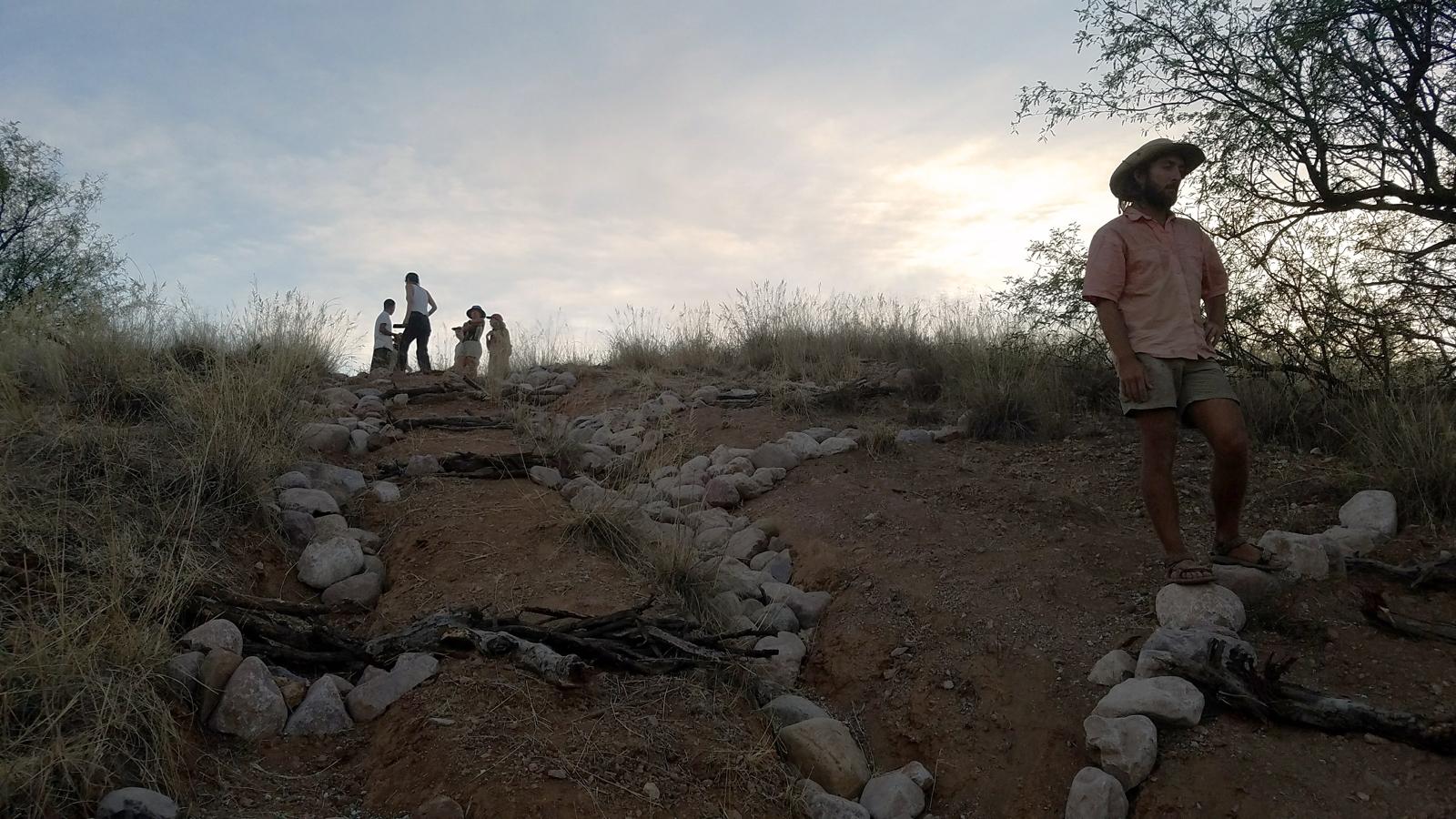
    A non-profit collective known as Borderlands Restoration of southern Arizona is pursuing experimental theories of collective conservation and adaptive environmental husbandry with a relentless fervor. The assorted collaboration of folks at BR are working in the flood plains of southern Arizona to prevent further erosion of soil within arroyos, or washes, so that vegetation may hold fast.  As humans began to over develop the desert and divert water to unnaturally irrigated landscapes, soil erosion in this environment has been rampant, destroying the biodiversity of the area. So the BR has begun to design and build a series of patterned check dams built from locally sourced mesquite branches, or recycled chunks of cement or “overburden” from local mines. The styles are referred to as media lunas, trencheras, and Zuni bowls. These three shapes create patterns strategically spaced throughout the arroyos and flood plains, beautifully woven into the landscape- indicative of both aesthetic and functional compositions. This type of creative resistance, implemented through the intervention of human hands, is left alone to allow nature time and space to recover, an optimistic salute to art that heals.

    November 4, 2017

    Slow the water, retain sediment, allow recovery

    By Mikala Sterling
    Patagonia, AZ
    October 22, 2017

    We camped in an old school yard and spent the week learning and working with the
    Borderlands Restoration group. The end of the week culminated in working
    together to build rock walls on a very steep hill to potentially slow erosion and
    rehabilitate the space.


    A few notes/thoughts from our week in Patagonia:
    “work in anticipating the unraveling of land”
    “What are our roles as ethical creatures?”
    “put your body where your ethics are”
    “how we mark space to create and represent meaning over time”
    “understanding – across space”
    “deep hanging out – spending time with a space”
    “reading the landscape”
    “heals as an empathetic entity”