Showing posts with label nicholas b jacobsen. Show all posts

November 29, 2018

on edge(s)

nicholas b jacobsen
on edge(s)
White Sands (National Monument/Missile Range)
November 7, 2018
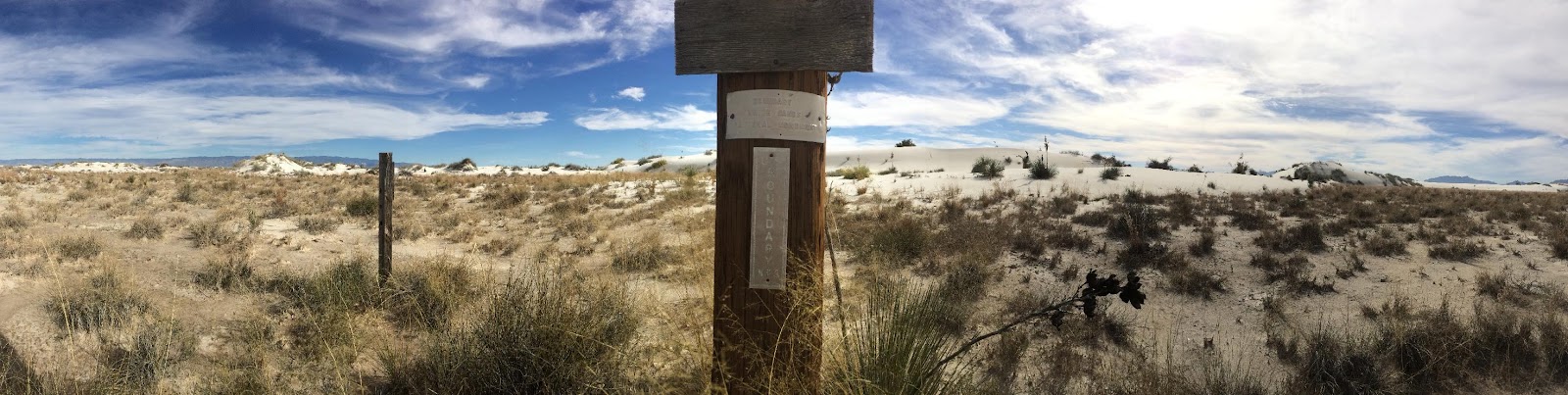
Macintosh HD:Users:nicholasjacobsen:Desktop:IMG_8827.jpg


"The White Sands dunefield fits the description of what the National Park Service sought in prospective sites: 'economic worthlessness and monumentalism'" (White Sands).
 Macintosh HD:Users:nicholasjacobsen:Desktop:whitesandsmap.jpg 

*clears throat* 
Let me start again.


"Like a mirage, dazzling white sand dunes shimmer in the tucked away Tularosa Basin in southern New Mexico. They shift and settle over the Chihuahuan Desert, covering 275 square miles--the largest gypsum dunefield in the world. White Sands National Monument (WSNM) preserves more than half of this oasis, its shallow water supply, and the plants and animals that live here" (White Sands). Those plants and animals that wander across into the other half do so at their own risk, as they enter the "Department of Defense (War)'s largest, fully-instrumented, open air range, provid(ing) America's Armed Forces, allies, partners, and defense technology innovators with the world's premiere [sic] research, development, test, evaluation, experimentation, and training facilities to ensure our nation's defense readiness," in White Sands Missile Range (WSMR). 
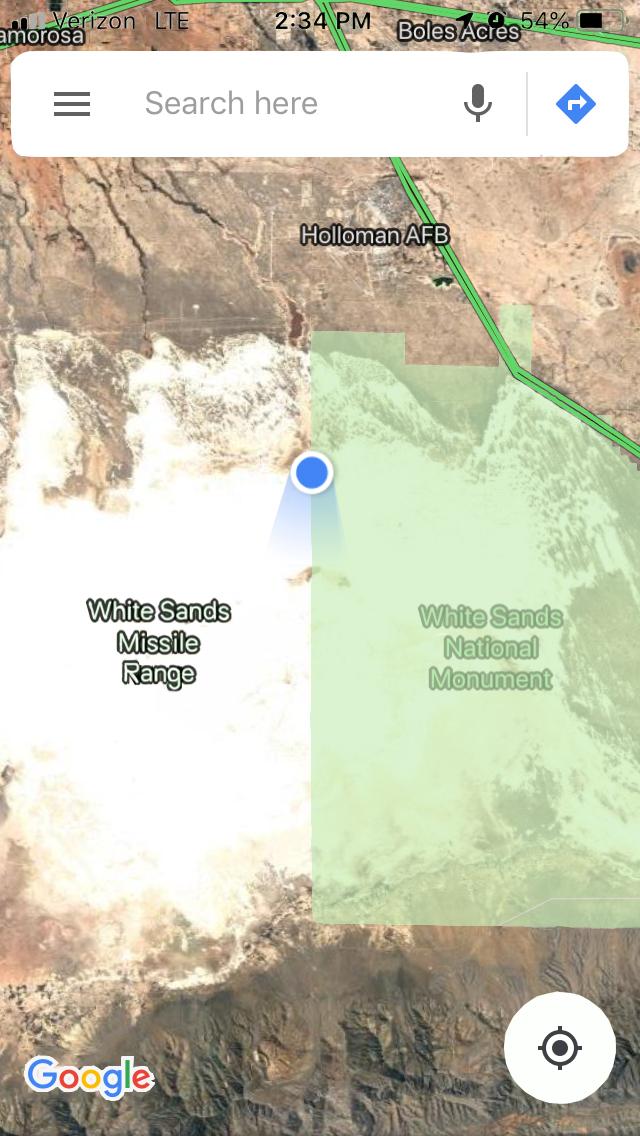

Macintosh HD:Users:nicholasjacobsen:Desktop:whitesandsmap.jpg


        I walked to this line in the white sands, to try to understand this divide. How did the Department of War, (as the DoD was known when WSMR was first developed), choose this site? What were the reasons to divide "one of the world's great natural wonders" (White Sands)? I want to understand how we can so easily split our land values. How is this land half National Monument and half National Sacrifice?


        A focal question of my research practice is "How is that Western humans believe themselves to be the peak of natural selection and the only unnatural force on earth?" This line, where federal land is divided from federal land, is a living, corporeal example of this split consciousness that we all carry around concerning our collective body, earth. 
        Frankly, I didn't learn much here. The sand isn't different. The plants and animal tracks didn't change. Maybe I didn't walk far enough, maybe in another hundred yards, or couple miles the land is less unique, dazziling, or naturally wonderful. Maybe "our nation's defensive readiness" (ready for what?) is more valuable than our nation's ecological sustainability. Maybe I am looking at this backward. Perhaps, the values through which I read this situation are not our nation's values. Maybe the national monument is the national sacrifice. Did we sacrifice some of our more-valued national defense for our less-valued ecology? This would seem to be the case as even our WSNM's website perpetuates a narrative of escalated violence as linear progress. "From atlatls to missiles, the glistening gypsum dunefield of White Sands has witnessed the steady advancement of human history, technology, and engineering. For thousands of years the people have called this place home" (White Sands) Not only does this equate weapons for food to weapons for war (but then from an imperialist perspective, are they not both technologies for the acquisition of resources?) but also alludes that attempted genocide and forced removal of peoples from their homelands is all part of a "steady advancement of human history." 
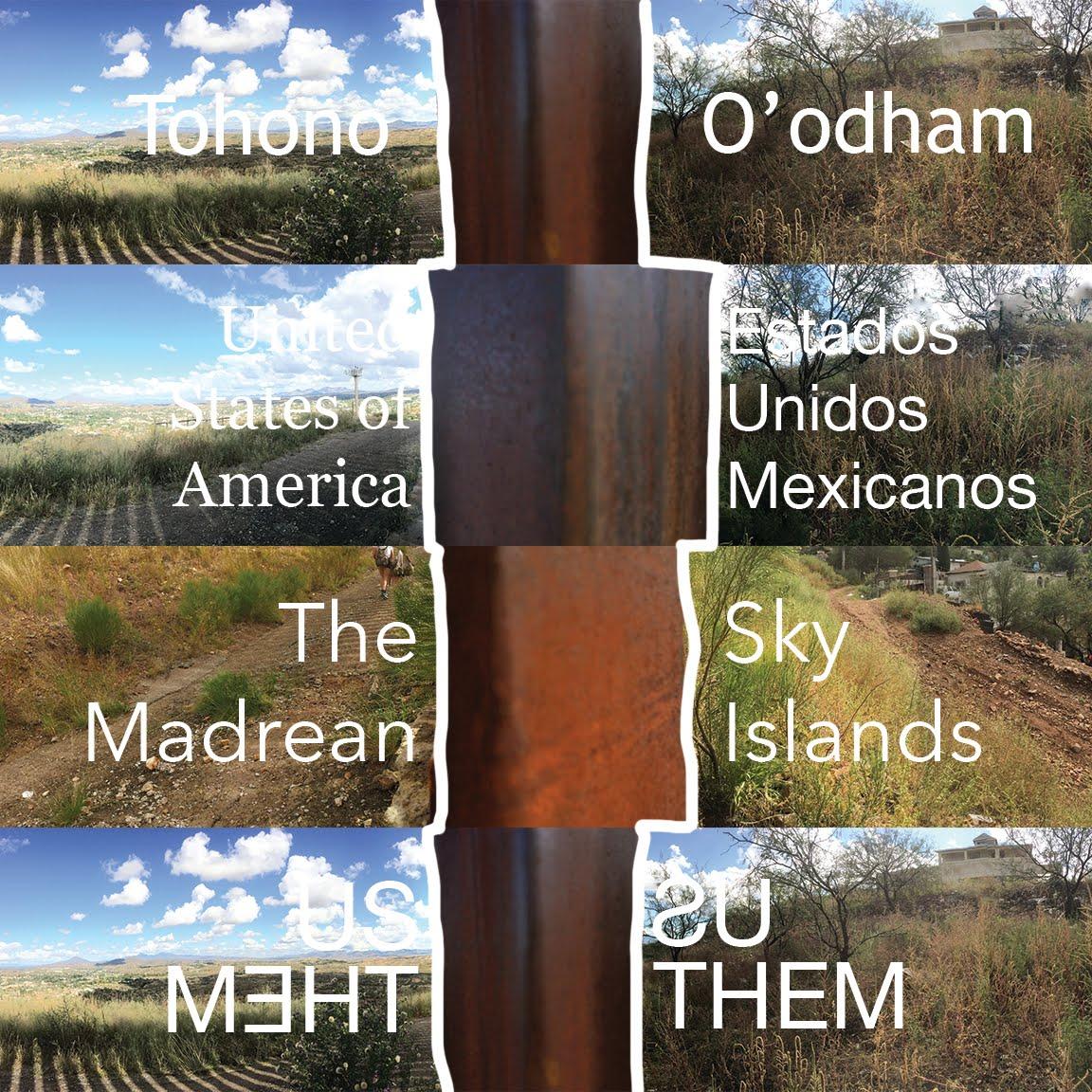
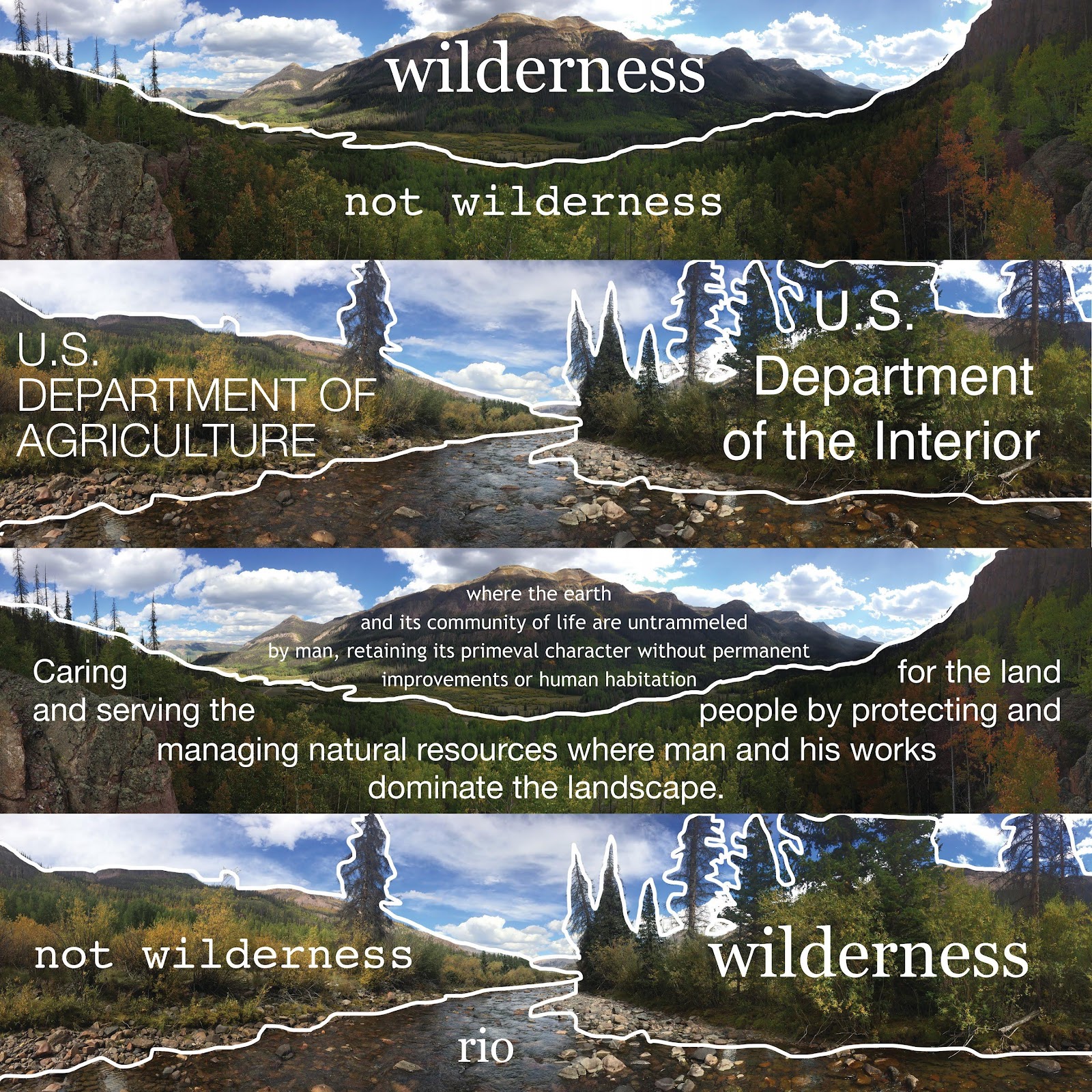
        As part of this attempt to understand edges, especially the psychological justifications for these divisions, I made series of images using panorama pictures from three different boundaries we visited during this year's Land Arts tour: WSNM/WSRM, United States of America/Estados Unidos Mexicanos, and Rio Grande National Forest/Weminuche Wilderness. Overlaying these images (which themselves overlay the lands depicted) are bits of found language used to describe these places--different names that create different boundaries, expectations, values, responsibilities, and norms for these spaces. 
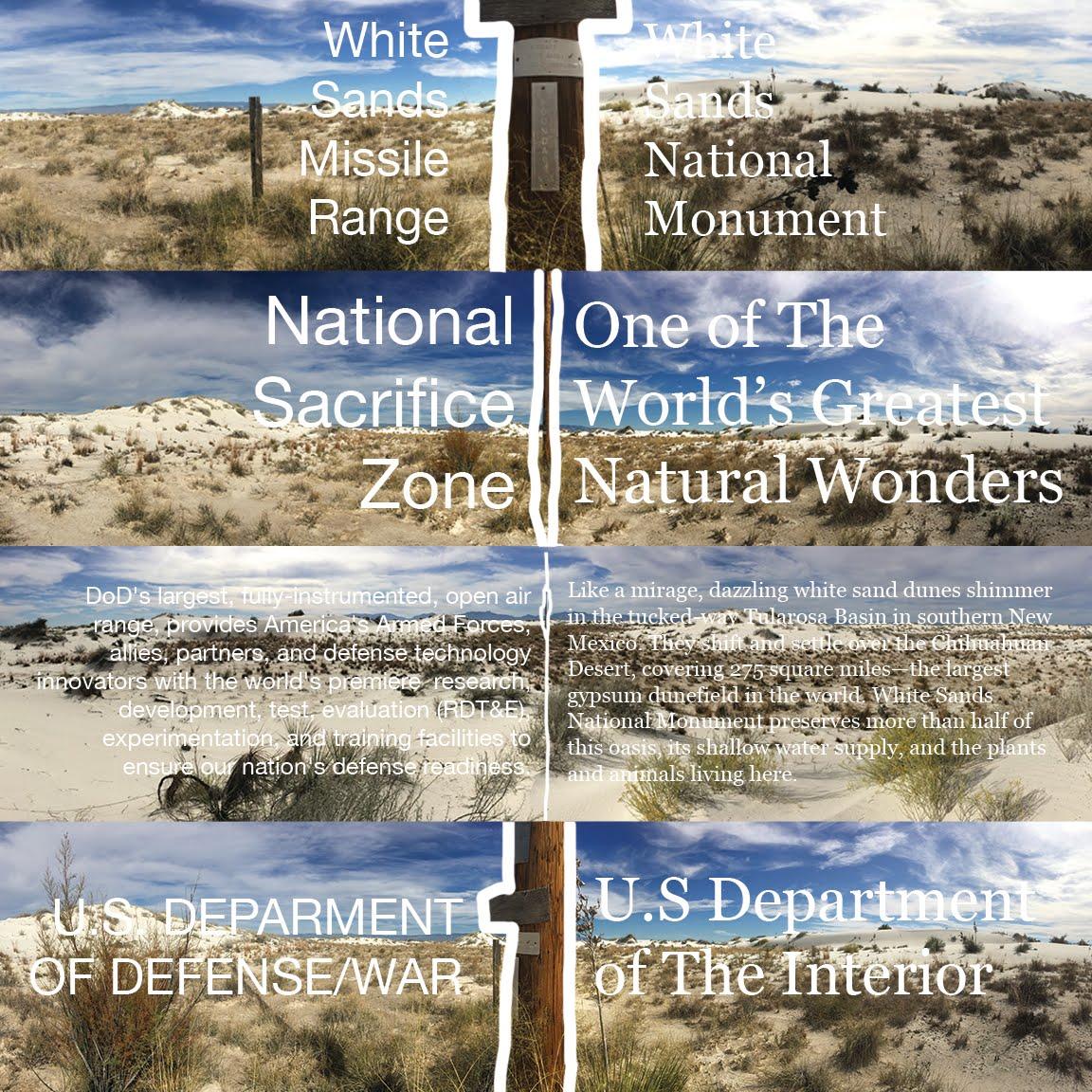


Macintosh HD:Users:nicholasjacobsen:Desktop:white_sands.jpg


Macintosh HD:Users:nicholasjacobsen:Desktop:us_mexico.jpg


Macintosh HD:Users:nicholasjacobsen:Desktop:wild_notwild_2.jpg


Bibliography
"WSMR, White Sands Missile Range." www.wsmr.army.mil. Nov. 7, 2018.
"White Sands National Monument." www.nps.gov/whsa/index.htm. Nov. 7, 2018.

November 13, 2018

tension, a sense of inbetweeness

nicholas b jacobsen
tension, a sense of inbetweeness 
Borderlands, AZ
November 7, 2018


Macintosh HD:Users:nicholasjacobsen:Desktop:border3 2.jpg

        Immediately, I was struck by its sculptural beauty. The equidistant spacing of the raw, rusting, steel bars; the shadows cast on the road running parallel in the midday, mid-fall light--it seemed like Donald Judd, Richard Serra, and Christo and Jeanne Claude had all collaborated on a work of minimalist monumentality. Immediately tailing that feeling was a feeling of self-repulsion. How could I find something so violent, so racist, and so authoritarian beautiful? How can something's visual presence mentally block its political/social/economic presence so easily, and for that moment, so completely? 
        We left the border fence and went to a park in Nogales, AZ where met to talk about our impressions of this place. When I brought up my visceral reaction to the fence as an object, Paco spoke about Trump's rhetoric of a "big, beautiful wall" and how he had just put this in with all the other ridiculous things Trump says. He'd never considered that some might find it beautiful. 
        Granted, the thought/feeling was only briefly isolated and then immediately met with the conceptual/contextual layer, but it was so much visceral and immediate. So much so that I actually uttered aloud, "it's so beautiful," when we rounded the corner and it first came into view.
        I wonder how much the normalcy with which we all live with the wall--those whose everyday life is lived in proximity to it and those of us for whom the wall is only a part of our mental/political landscape--allowed me to be able to forget about the many other layers this object exists within and only notice it as a piece of land art, an immense sculpture rising out of and mimicking the curves of this mountainous landscape--a line that undulates when facing it and runs land-surveyor straight when looking down it's length. It's straightness and equidistant spacing seems to communicate an order, an almost natural order to its existence, as if it were meant to be there. The way it followed the curves of the land, no matter how steep, also lends to this sense of naturalness, its supposed inevitability, its normalcy. 

Macintosh HD:Users:nicholasjacobsen:Desktop:border2 2.jpg
        
        As a line stands inbetween two places (at least two) it holds so many inbetweens. This line holds surprising feelings of everydayness--clothes drying on the line, grasses waving in the breeze, school kids yelling and playing, mountains climbing, pigeons flying, trash piling. Simultaneously it hold feelings of heightened alertness with military airplanes and helicopters, border patrol trucks, huge steel bars and plates, doors with bolts as think as beams, cameras watching, alarms alarming. These simultaneous and dissonant feelings, sights, and sounds create a tension, a sense of inbetweeness. 


Everything is fine--You're being watched. 


Macintosh HD:Users:nicholasjacobsen:Desktop:border4 2.jpg


        Pigeons rest on this line as they would any other tall structural ledge. Cats pass through like any other fence. Persons are blocked, threatened, arrested, and/or murdered. Families are separated. Children traumatized. Laundry dries in the warm autumn sun.

October 21, 2018

between home and a hard place

nicholas b. jacobsen
between home and a hard place
 Muley Point
October 12, 2018


         Utah is a place that is very close to the trouble for me. There, I am inbetween so many things--between the family I was born into and the family I have made since leaving Utah, between the land that is home to me and the culture in which I am no longer welcome, between everything I come from and everything I've become, between home and a rock place. 
        "Trouble is an interesting word. It derives from a thirteenth-century French verb meaning 'to stir up,' 'to make cloudy,' 'to disturb'" (1). Trouble is just what Donna Haraway's Staying with the Trouble did for my practice in Muley Point. Things that seemed clear (what I am doing, how I want to do it, and my sense control and connection to the work) became stirred up, clouded, disturbed--more troubled with each page I consumed. My cosmologies are rooted in my spiritual practice that has its tentacles in Shambhala Buddhism, Taoism, psychedelic experiences in my early 20's, and the rocks that I became-with at that time. I know of cyclical systems of being, especially over long periods of time, like the rock cycle. I know from meditation of a powerful force that undergirds all action and can easily be misunderstood as inaction. Haraway troubles all of this for me. She writes of the importance of non-innocence in our becomings. She emphasizes the tentacular to the cyclic. She makes me wonder what I am doing. 
        I see myself slowly shifting the very foundations my culture has been built upon, like lichen softens the rock to sand. I see myself becoming-with the unruly, the out-casted, the undesirable, the uncomfortable, and the aching--but do I try to do this innocently? Do I misunderstand or misuse the Buddhist concept of "do no harm"? Is it possible to do no harm when living and dying on a damaged planet?
         Because of this troubling of my mental and emotional spaces (which were already troubled in our time with Daniel Tso in the Fracking is Fracking Reality Tour AND then being in and with my homeplace, which reawakened my own ""originary' trauma" (92) with my familial and community kin) I think I spent most of my practice trying to find a new space of stability in this whirling, muddled, ongoing processes of living and dying found in so many spacial, temporal, geophysical, political, economic, existential layers. But isn't this false sense of stability exactly what Haraway (and one of my other favorite troublers, Pema Chödrön) wants to trouble? I struggle leaving these spaces of seeming stability because I don't trust what I will do outside of them. Being raised by a violent, sexual predator father in a nearly omnipresently patriarchal sub-culture within the dominant imperialist, white-supremist, heteropatriarchy--how can I trust myself to work from a place of instability where I can't keep a close eye on my intuitions and unthinking actions? As a white man, in this three-layer cake of toxic masculinity, frosted with privilege, how can I learn to decolonize my mind (and thus my words and actions) without these spaces of relative safety from which to learn? How can I trust my intuitions when they've been shaped and encouraged to be the very thing that I am working to change? How can I act in non-innocence without perpetuating the kind of damage I am heir to, the kind of damage that is killing us all? 
        I recognize that I will make mistakes as I learn and do, and that that is part of action, but these various originary traumas are paralyzing in such a complex ongoing worlding of oppression, dominance, and violence. 
        This is what I think came of our time near Bears Ears--another reminder, and jolt, to get deeper, take more risk, and be open to learn from the inevitable face-plant-in-the-mud-and-muck that comes-with--AND to learn to trust that process and myself, while remaining gently critical of both.


between home and a hard place is an ongoing, unfinished, especially vulnerable effect of Staying with the Trouble. 


Bibliography
Haraway, Donna J. Staying with the Trouble: Making Kin in the Chthulucene. Duke University Press: Durham and London. 2016.

October 14, 2018

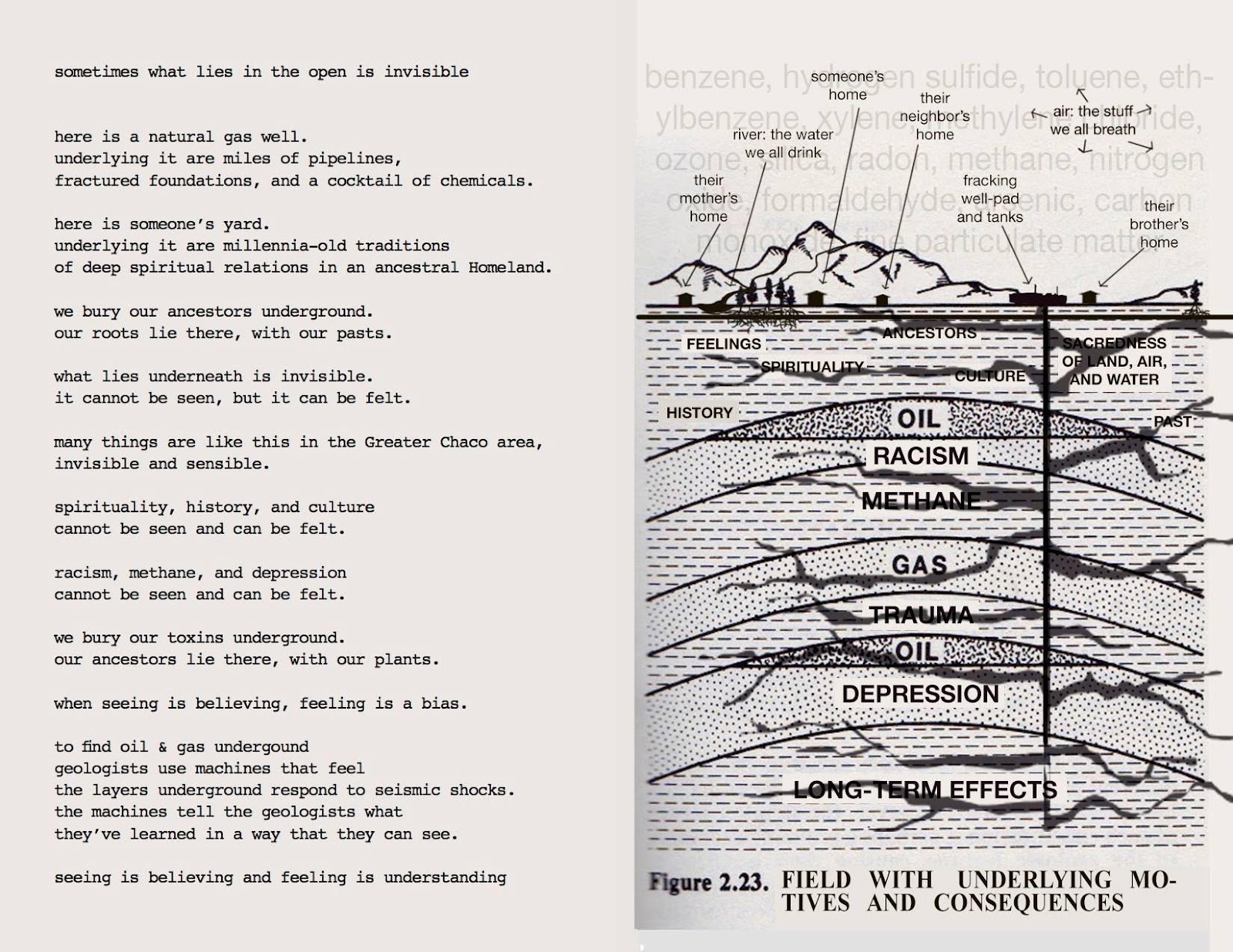
sometimes what lies in the open is invisible

nicholas b jacobsen
sometimes what lies in the open is invisible
Four Corners
October 12, 2018

Everyone who reads this entry is connecting with the lives within the sacred lands of Diné (Navajo) and Pueblo Peoples. As we begin our communications, let us fully acknowledge the place from where this writing originates and give thanks to the mountains, valleys, and waters, which sustain our lives, and form Diné and Pueblo ancestral homelands. Let us ground our interactions in awareness of where we are and may the mannerisms of Diné and Pueblo Peoples enter our lives and fill us with gratitude, love, care, and respect for all that is shared between us and all beings.
After experiencing the complex, heartbreaking reality of the Fracking is Fracking Reality Tour, led by Daniel Tso, we spent some time absorbing and reflecting. We heard about the fractured social and physical health of the communities in Northwestern New Mexico. We saw the oppressive density of oil and gas wells. We smelled and tasted their toxic tailings. We listened to the omnipresent vibrations of the pumps. We touched the poisoned ground, where seeds of sustenance and lives of ancestors lie. We felt the heartaches and headaches that daily impact the lives of those whose homes are deeply rooted here in the “national sacrifice zone.”
We were charged by this community to hold this experience within our hearts and to share what is forming there with our communities. In there own words, we pass this charge on to you.

“We’re speaking from the heart, in the hopes that it touches your heart, motivates you to join our work. This is a critical time. The balance of nature is disrupted. We all need clean air, water, a place to live. Talk to your family, friends. Ask them to call and write to their representatives. I hear there is a thing called ‘Instagram.’ You can Instagram it.” - Daniel Tso

“The reality that we’re facing is we need help. People are dying. The land and water are suffering. We shouldn’t need a PhD to say harm is happening. It’s the culture of violence that needs to be disrupted--violence on our land, violence on our communities.
It’s time to take a hard stand, what side we’re on.
Are we for life or death?
Peace or violence?
It’s going to come with a lot of sacrifice, changes in the way we live. We were given everything we need--land, water, seeds. We now have an obligation to grow together. We need everyone to work together, because of the urgency.” - Anonymous


Macintosh HD:Users:nicholasjacobsen:Desktop:invisible.jpg

For more information and to learn how you may help the efforts already underway, please visit the Greater Chaco Coalition @ frackoffchaco.org, and on Facebook, Twitter, and Instagram

Thank you

October 10, 2018

root

nicholas b. jacobsen
root
Wild Rivers
September 21, 2018


*This is a poem inspired by roots, the theme of this year's Neo Rio.
(Included is a mental map of roots.)

what is root?
a noun and a verb
a division and connection
a path and a past
orgin and an end

the root word
of
the word root
also means branch
roots branching out as tree branches branch
into the air
gathering clouds, seeding rain, feeding roots
of rocks, rivers, flora, fauna,
us

my family roots are twisted
spread 'cross ocean and
blood lines pulsing in my veins
rooting my to others,
uprooted as we settled
divided as we spread

beet roots uprooted remind me of home
my step-dad always hated them
with him we were uprooted from the place i was born
i'm rooted, now, there
to the red rocks where we moved
and found family elsewhere
as i continue
uprooting
rerooting
carrying
home with me
in the iron in my blood, red
as the ground where i grew

i now live where route 66
and the rio grande
intersect.
the road connects
east to west
the river divides
U.S. from them

rooting around in my mind
which is rooted in my nerves
ending in my soles
rooted in the soil
grounding me here
with you


September 27, 2018

we are not the sole bearers of consciousness

nicholas b. jacobsen
we are not the sole bearers of consciousness
Headwaters
September 21, 2018


I have been thinking about the way we learn and talk about our shared, sustenance-providing, planet-place. I made the above photo-poem thinking about the camera and the image--what its place is in cocreating our present moment and why I am drawn to using it.
Thinking about how we receive and share our ideas, I want to share some thoughts on my barefoot walking practice with you. I know this process is transformative and for me has been healing, but I have yet to figure out how to directly share it with others in my humanimal community while also leaving room for  each individual's personal exploration and expression. The following writing does not hope to hold or illustrate these experiences, but maybe it can be a direction or sign-post, pointing to the place where the body can go and no words can follow.
At the headwaters of the Rio Grande, I spent most of my time walking barefoot in the mountainsides cupping the river valley. This practice started as a way of grounding. I was reticent about it at first. I learned about it from my brother who is very open-minded--to the point of believing conspiracy theories that, to me, are escapist mental practices. Simultaneously, he is the one who introduced me to Pema Chödrön's writing, which is now foundational in my daily practices.
Once I began to feel the many, many textures and temperatures touching my feet, I felt a connection to and understanding of the places I walked more deeply than ever before. With immediacy, I could feel where the ground was moist and (for)giving, where the ground was dry and coarse (though no trail is as consistently hard and unforgiving as the concreted grids we fill our densely human places with), and where the ground invited or discouraged my steps.


I'm still not sure how to communicate the wholeness of these sensuous experiences (besides suggesting that you expose your feet and feel for yourself), but there is a profound exchange between my body and the multiform earth body/bodies. Like most open exchanges, vulnerability and risk are required to participate--a threshold must be crossed. My feet have been cut, scratched, bruised, and penetrated, and it hurt, sometimes for days after. But this pain and risk is endlessly worth it. To be able to feel the ever-shifting presence surrounding and permeating me--the humidity changing as I enter an underground water valley, the cool squish of mud in my toes, the warmth of sunbaked humus, the give of a moss patch, and to watch that same moss expand and erase my footstep--creates a sense of embeddedness with/in this seemingly endlessly expansive earth body, a feeling that I belong here.

"We can feel the trees and the rocks underfoot, because we are
not so unlike them, because we have our own forking limbs and
our own mineral composition, because...we are not pure mind-
stuff, but are tangible bodies of thickness and weight" (Abram, 46)


These feelings simultaneously relieve the alienation I inherited from my culture with its roots in hierarchical Judeo-Christianity, divisive Cartesian ideology, and dissociative Western science practices, and the anxiety created by the ideology that we humans are the only ones with the agency and thus the only ones responsible for healing our poisoned ecosystems (though we, as a culture, are responsible for the damage). Being taught, in church, that I am an implant on this planet--that I was created elsewhere and deposited here--and learning in school that the only way to understand this illusory physical world is by retaining this sense of objective outsiderness (the fact that we call these diversely co-created space that are beyond-human outside is telling), while at the same time feeling the wisdom of trees, rocks, seeds, cycles, giving, and grounding cemented this divide, assured the truth of my dissociative alienation.


When my culture tells me that to believe my intuitions and quiet sensations is to fall for folly--a weakness that must be tempered, conquered, and negated through strength of will, a courage to face the hard facts, and a coldness that enables progress--their truth is affirmed. I am divided. I do feel alienated, displaced, and confused, thus giving up my own will to that of the authorities of religion and academia.
To trust yourself is a risk--a risk that should be taken with criticality, gentle openness, and patience--that must be taken to unite our ancient bonds (and untie our modern bonds) that can heal our lonelinesses, anxieties, depressions, and destructively desperate habits of grasping for constant comfort, control, and numbing security.
I have been reading David Abram's Becoming Animal and his poetic, paragraph long points have filled my own thought-patterning this last month. So, now I share it with you, dear reader, in my writing and this quote from David:


"As we breathe out, letting mind flow back into the field that
surrounds us, we feel a new looseness and freedom. The other
animals, the plants, the cliffs, and the tides are now participant in
the unfolding of events, and so it no longer falls upon us, alone,
to make things happen as we choose. Since we are not the sole
bearers of consciousness, we are no longer on top of things, with
the crippling responsibility that that entails. We're now
accomplices in a vast and steadily unfolding mystery" (131).


Bibliography
Abram, David. Becoming Animal: An Earthly Cosmology. Vintage Books: NY, NY, 2010.